 Add to Chrome
 Add to Firefox
 Add to Edge
MemGym: a Long-Horizon Memory Environment for LLM Agents
May 20, 2026
Memory is a central capability for LLM agents operating across long-horizon tasks. Existing memory benchmarks predominantly evaluate retention of personalized information in multi-turn chat scenarios, overlooking the dynamic memory formation that occurs during extended agent execution. Consequently, the memory systems they produce transfer poorly to realistic agentic environments, such as coding and web navigation. We present MemGym, a benchmark for agentic memory that unifies existing agent gyms and in-house memory-grounded pipelines behind one memory-reasoning interface. MemGym spans five evaluation tracks grouped into four agentic regimes: tool-use dialogue (tau2-bench), multi-turn deep-research search (MEMGYM-DR), coding (SWE-Gym and MEMGYM-CODEQA), and computer use (WebArena-Infinity). MemGym reports memory-isolated scores that decouple memory performance from reasoning, retrieval, and tool-use ability, so memory strategies can be ranked without those confounders. Our synthetic pipelines for MEMGYM-CODEQA and MEMGYM-DR are length-controllable, ablation-verified at every stage, and tightly aligned with downstream scenarios. To make evaluation on coding environments academically tractable, we train MemRM, a lightweight reward model (Qwen3-1.7B fine-tuned with QLoRA) that scores compression quality as a fast scalar read in place of full Docker rollouts.

UniVL: Unified Vision-Language Embedding for Spatially Grounded Contextual Image Generation
May 20, 2026We introduce spatially grounded contextual image generation, a controllable image generation task that reframes the conditioning paradigm. Instead of supplying a reference image and a global text prompt through two separate encoders, one for vision and one for language, UniVL is trained to bind semantics to spatial locations directly from a single unified visual input, where the textual instruction is rendered onto the spatial mask. This removes the need for a standalone text encoder at inference time. The resulting model supports contextual image generation by following user-specified instructions about what should appear where, while substantially reducing computation. To address this task, we propose a framework in which the UniVL encoder, adapted from an optical-character-recognition-pretrained backbone, reads the unified condition optically and produces a UniVL embedding, fVIL, that fuses visual and semantic intent with spatial locations in a single token sequence. A two-stage pipeline first aligns UniVL with the VAE embedding space and then conditions a pretrained diffusion backbone entirely on UniVL embeddings, eliminating the standalone text encoder, such as T5. Although this reframing uses a deliberately minimal text interface, it yields strong empirical gains. On UniVL-ImgGen, a benchmark of 477K mask-annotated images that we construct for training and evaluation, UniVL improves image quality over text-prompted baselines, reducing FID from 14 to 11 and increasing PSNR from 16 to 20. It also eliminates the text encoder entirely, reducing inference TFLOPs by up to 52% and runtime by up to 44%. Additional ablation studies validate the contributions of the proposed components, paving the way for efficient, spatially grounded image generation with a unified conditioning paradigm.
Evidence Over Plans: Online Trajectory Verification for Skill Distillation
May 09, 2026Agent skills can remarkably improve task success rates by using human-written procedural documents, but their quality is difficult to assess without environment-grounded verification. Existing skill generation methods heavily rely on preference logs rather than direct environment interaction, often yielding negligible or even degraded gains. We identify that it is a fundamental timing bottleneck: robust skills should be posterior-based, distilled from empirical environment interaction rather than prior plans. In this study, we introduce the Posterior Distillation Index (PDI), a trajectory-level metric that quantifies how well a distilled skill is grounded in the task-environment evidence. To operationalize PDI, we present SPARK (Structured Pipelines for Autonomous Runnable tasKs and sKill generation) for preserving task execution evidence towards full trajectory-level analysis. SPARK generates environment-verified trajectories used to compute PDI, and it applies PDI as an online diagnostic and intervention signal to ensure posterior skill formation. Across 86 runnable tasks, SPARK-generated skills consistently surpass no-skill baselines and outperform human-written skills on student models (inference cost up to 1,000x cheaper than teacher models). These findings show that PDI-guided distillation produces efficient and transferable skills grounded in the task-environment interaction. We release our code at https://github.com/EtaYang10th/spark-skills .
EvoSkills: Self-Evolving Agent Skills via Co-Evolutionary Verification
Apr 02, 2026Anthropic proposes the concept of skills for LLM agents to tackle multi-step professional tasks that simple tool invocations cannot address. A tool is a single, self-contained function, whereas a skill is a structured bundle of interdependent multi-file artifacts. Currently, skill generation is not only label-intensive due to manual authoring, but also may suffer from human--machine cognitive misalignment, which can lead to degraded agent performance, as evidenced by evaluations on SkillsBench. Therefore, we aim to enable agents to autonomously generate skills. However, existing self-evolving methods designed for tools cannot be directly applied to skills due to their increased complexity. To address these issues, we propose EvoSkills, a self-evolving skills framework that enables agents to autonomously construct complex, multi-file skill packages. Specifically, EvoSkills couples a Skill Generator that iteratively refines skills with a Surrogate Verifier that co-evolves to provide informative and actionable feedback without access to ground-truth test content. On SkillsBench, EvoSkills achieves the highest pass rate among five baselines on both Claude Code and Codex, and also exhibits strong generalization capabilities to six additional LLMs.
Memex(RL): Scaling Long-Horizon LLM Agents via Indexed Experience Memory
Mar 04, 2026Large language model (LLM) agents are fundamentally bottlenecked by finite context windows on long-horizon tasks. As trajectories grow, retaining tool outputs and intermediate reasoning in-context quickly becomes infeasible: the working context becomes prohibitively long, eventually exceeds the context budget, and makes distant evidence harder to use even when it is still present. Existing solutions typically shorten context through truncation or running summaries, but these methods are fundamentally lossy because they compress or discard past evidence itself. We introduce Memex, an indexed experience memory mechanism that instead compresses context without discarding evidence. Memex maintains a compact working context consisting of concise structured summaries and stable indices, while storing full-fidelity underlying interactions in an external experience database under those indices. The agent can then decide when to dereference an index and recover the exact past evidence needed for the current subgoal. We optimize both write and read behaviors with our reinforcement learning framework MemexRL, using reward shaping tailored to indexed memory usage under a context budget, so the agent learns what to summarize, what to archive, how to index it, and when to retrieve it. This yields a substantially less lossy form of long-horizon memory than summary-only approaches. We further provide a theoretical analysis showing the potential of the Memex loop to preserve decision quality with bounded dereferencing while keeping effective in-context computation bounded as history grows. Empirically, on challenging long-horizon tasks, Memex agent trained with MemexRL improves task success while using a significantly smaller working context.
TokenSeek: Memory Efficient Fine Tuning via Instance-Aware Token Ditching
Jan 27, 2026Fine tuning has been regarded as a de facto approach for adapting large language models (LLMs) to downstream tasks, but the high training memory consumption inherited from LLMs makes this process inefficient. Among existing memory efficient approaches, activation-related optimization has proven particularly effective, as activations consistently dominate overall memory consumption. Although prior arts offer various activation optimization strategies, their data-agnostic nature ultimately results in ineffective and unstable fine tuning. In this paper, we propose TokenSeek, a universal plugin solution for various transformer-based models through instance-aware token seeking and ditching, achieving significant fine-tuning memory savings (e.g., requiring only 14.8% of the memory on Llama3.2 1B) with on-par or even better performance. Furthermore, our interpretable token seeking process reveals the underlying reasons for its effectiveness, offering valuable insights for future research on token efficiency. Homepage: https://runjia.tech/iclr_tokenseek/
Reasoning over Precedents Alongside Statutes: Case-Augmented Deliberative Alignment for LLM Safety
Jan 12, 2026Ensuring that Large Language Models (LLMs) adhere to safety principles without refusing benign requests remains a significant challenge. While OpenAI introduces deliberative alignment (DA) to enhance the safety of its o-series models through reasoning over detailed ``code-like'' safety rules, the effectiveness of this approach in open-source LLMs, which typically lack advanced reasoning capabilities, is understudied. In this work, we systematically evaluate the impact of explicitly specifying extensive safety codes versus demonstrating them through illustrative cases. We find that referencing explicit codes inconsistently improves harmlessness and systematically degrades helpfulness, whereas training on case-augmented simple codes yields more robust and generalized safety behaviors. By guiding LLMs with case-augmented reasoning instead of extensive code-like safety rules, we avoid rigid adherence to narrowly enumerated rules and enable broader adaptability. Building on these insights, we propose CADA, a case-augmented deliberative alignment method for LLMs utilizing reinforcement learning on self-generated safety reasoning chains. CADA effectively enhances harmlessness, improves robustness against attacks, and reduces over-refusal while preserving utility across diverse benchmarks, offering a practical alternative to rule-only DA for improving safety while maintaining helpfulness.
Read the Scene, Not the Script: Outcome-Aware Safety for LLMs
Oct 05, 2025Safety-aligned Large Language Models (LLMs) still show two dominant failure modes: they are easily jailbroken, or they over-refuse harmless inputs that contain sensitive surface signals. We trace both to a common cause: current models reason weakly about links between actions and outcomes and over-rely on surface-form signals, lexical or stylistic cues that do not encode consequences. We define this failure mode as Consequence-blindness. To study consequence-blindness, we build a benchmark named CB-Bench covering four risk scenarios that vary whether semantic risk aligns with outcome risk, enabling evaluation under both matched and mismatched conditions which are often ignored by existing safety benchmarks. Mainstream models consistently fail to separate these risks and exhibit consequence-blindness, indicating that consequence-blindness is widespread and systematic. To mitigate consequence-blindness, we introduce CS-Chain-4k, a consequence-reasoning dataset for safety alignment. Models fine-tuned on CS-Chain-4k show clear gains against semantic-camouflage jailbreaks and reduce over-refusal on harmless inputs, while maintaining utility and generalization on other benchmarks. These results clarify the limits of current alignment, establish consequence-aware reasoning as a core alignment goal and provide a more practical and reproducible evaluation path.
EPO: Entropy-regularized Policy Optimization for LLM Agents Reinforcement Learning
Sep 26, 2025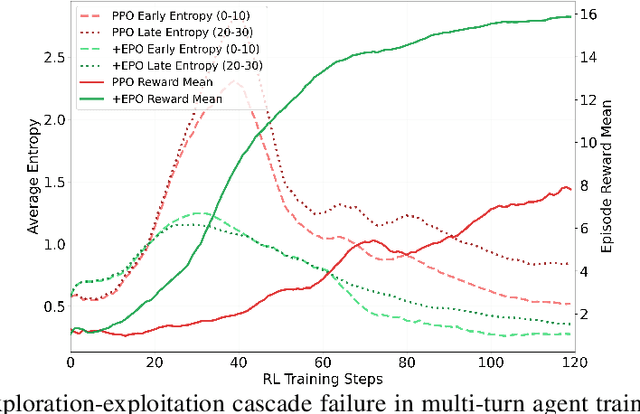
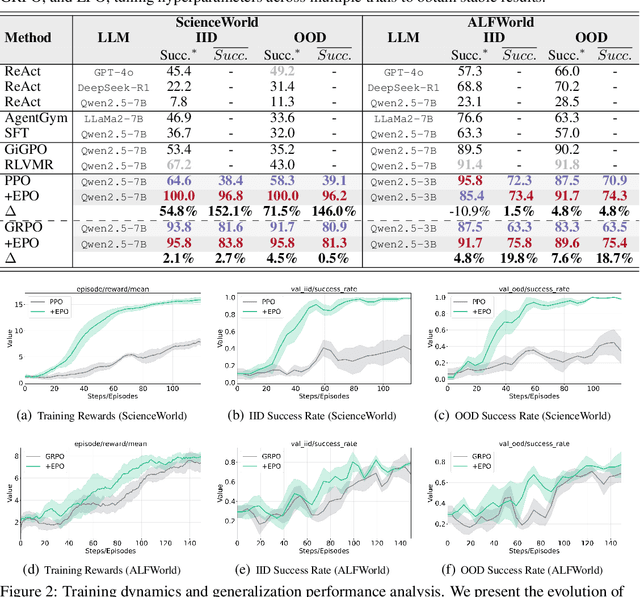
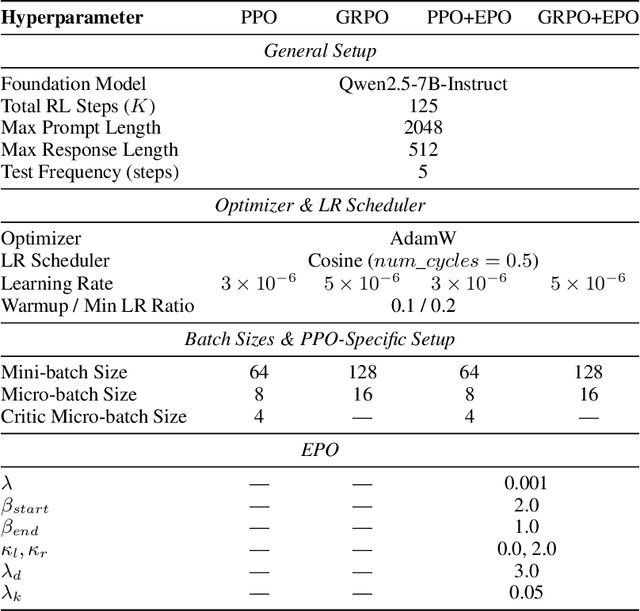
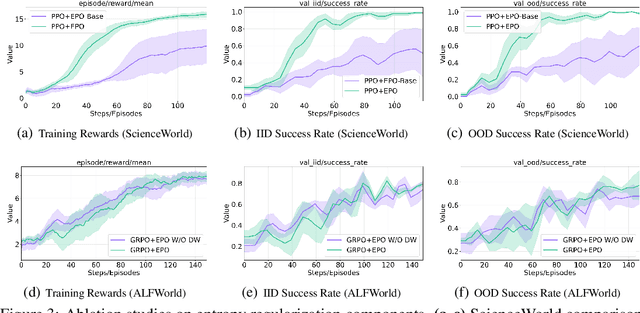
Training LLM agents in multi-turn environments with sparse rewards, where completing a single task requires 30+ turns of interaction within an episode, presents a fundamental challenge for reinforcement learning. We identify a critical failure mode unique to this setting: the exploration-exploitation cascade failure. This cascade begins with early-stage policy premature convergence, where sparse feedback causes agents to commit to flawed, low-entropy strategies. Subsequently, agents enter late-stage policy collapse, where conventional entropy regularization becomes counterproductive, promoting chaotic exploration that destabilizes training. We propose Entropy-regularized Policy Optimization (EPO), a general framework that breaks this failure cycle through three synergistic mechanisms: (1) adopting entropy regularization in multi-turn settings to enhance exploration, (2) an entropy smoothing regularizer that bounds policy entropy within historical averages to prevent abrupt fluctuations, and (3) adaptive phase-based weighting that balances exploration and exploitation across training. Our analysis justifies that EPO guarantees monotonically decreasing entropy variance while maintaining convergence. EPO achieves up to 152% performance improvement on ScienceWorld and up to 19.8% on ALFWorld. Our work demonstrates that multi-turn sparse-reward settings require fundamentally different entropy control than traditional RL, with broad implications for LLM agent training.
DUMP: Automated Distribution-Level Curriculum Learning for RL-based LLM Post-training
Apr 13, 2025Recent advances in reinforcement learning (RL)-based post-training have led to notable improvements in large language models (LLMs), particularly in enhancing their reasoning capabilities to handle complex tasks. However, most existing methods treat the training data as a unified whole, overlooking the fact that modern LLM training often involves a mixture of data from diverse distributions-varying in both source and difficulty. This heterogeneity introduces a key challenge: how to adaptively schedule training across distributions to optimize learning efficiency. In this paper, we present a principled curriculum learning framework grounded in the notion of distribution-level learnability. Our core insight is that the magnitude of policy advantages reflects how much a model can still benefit from further training on a given distribution. Based on this, we propose a distribution-level curriculum learning framework for RL-based LLM post-training, which leverages the Upper Confidence Bound (UCB) principle to dynamically adjust sampling probabilities for different distrubutions. This approach prioritizes distributions with either high average advantage (exploitation) or low sample count (exploration), yielding an adaptive and theoretically grounded training schedule. We instantiate our curriculum learning framework with GRPO as the underlying RL algorithm and demonstrate its effectiveness on logic reasoning datasets with multiple difficulties and sources. Our experiments show that our framework significantly improves convergence speed and final performance, highlighting the value of distribution-aware curriculum strategies in LLM post-training. Code: https://github.com/ZhentingWang/DUMP.